
 By Dr Lewis Kingsnorth DC MChiro, Chiropractor · GCC Reg. 3359 · Chiropractic First, Hove. Published October 2026 · Reviewed by the author · Next review October 2027
Feeling unsteady when you turn your head, or a little “off” after a long day hunched over a laptop, with a neck that feels stiff and sore? It’s natural to wonder whether the two are connected. Sometimes they are. Often they aren’t. Dizziness has many possible causes, most of them nothing to do with the neck, and a few that need urgent medical attention.
This guide explains what neck-related dizziness (also called cervicogenic dizziness) is, how it differs from other common causes of dizziness, the warning signs you should never ignore, and where chiropractic care fits in.
At a glance
- Dizziness is a symptom, not a diagnosis. Inner-ear problems are the most common cause of true spinning vertigo.
- Cervicogenic dizziness describes unsteadiness or light-headedness that comes with neck pain and stiffness. There is no single test for it, so it is only diagnosed once other causes have been ruled out.
- Dizziness with double vision, loss of vision, hearing loss, slurred speech, or weakness or numbness in an arm or leg is an emergency. Call 999.
- Chiropractic can help with mechanical neck pain and with headaches arising from the neck. We don’t claim to treat dizziness itself. Our role is a careful assessment, care for any mechanical neck problem we find, and referral when something else is going on.
Can your neck really make you dizzy?
Your sense of balance depends on your brain combining three streams of information:
- your inner ear (the vestibular system), which detects head movement and tilt
- your eyes, which tell you where you are in relation to your surroundings
- position sensors in your joints and muscles. The upper neck is particularly rich in these, constantly reporting where your head sits on your shoulders
Most of the time these signals agree. The theory behind cervicogenic dizziness is that when the neck is painful, stiff or not moving normally, the information it sends may no longer match what your eyes and inner ears are reporting. That mismatch can leave you feeling unsteady, disorientated or light-headed.
It’s worth being honest: cervicogenic dizziness is a debated diagnosis. There is no scan or blood test that confirms it, and when people with neck pain and dizziness are investigated thoroughly, another cause is often found. That’s why clinicians treat it as a diagnosis of exclusion, something you only conclude once other explanations have been checked.
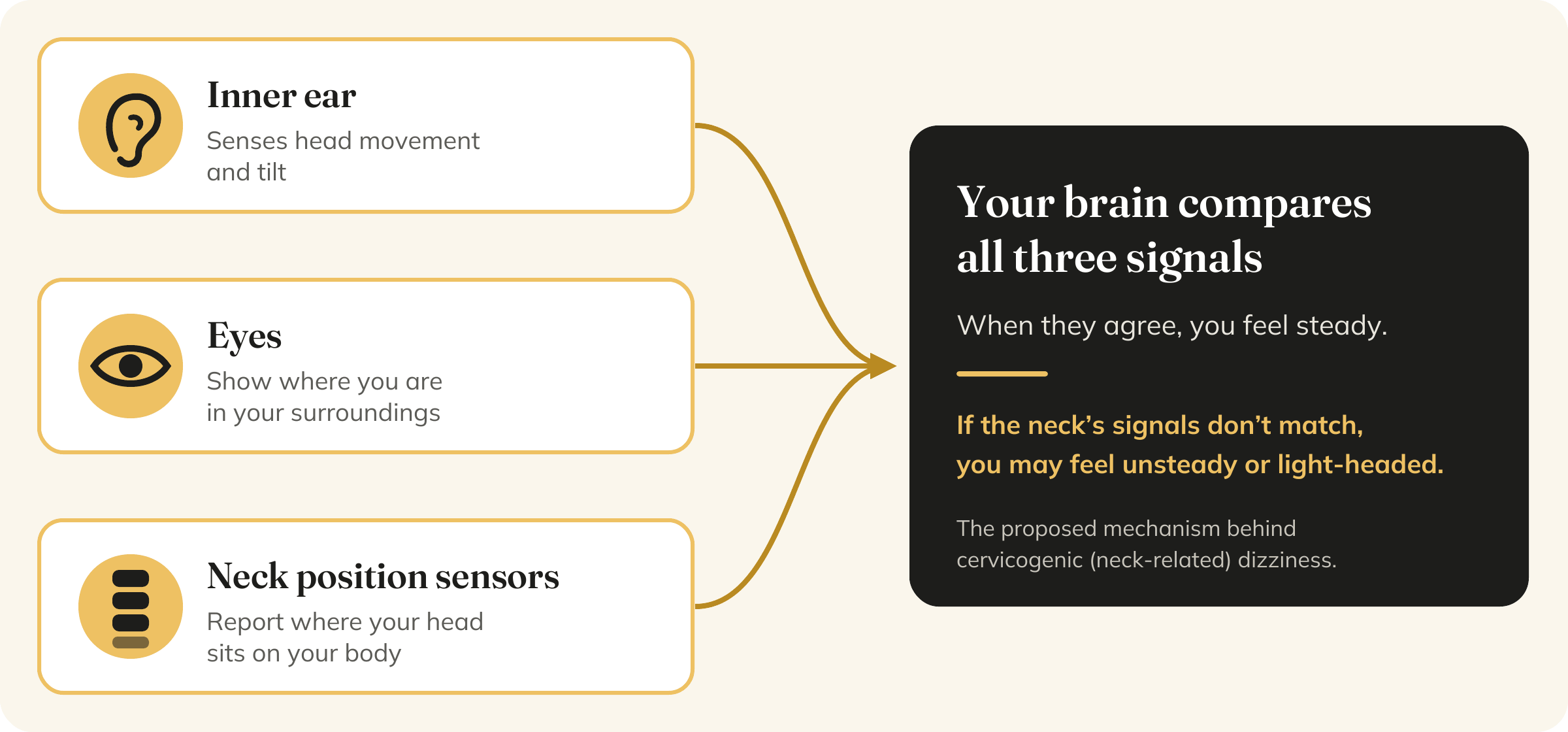
How balance works: your brain compares signals from the inner ear, the eyes and the neck.
What does neck-related dizziness typically feel like?
People who are eventually diagnosed with cervicogenic dizziness tend to describe a recognisable pattern:
- feeling off-balance, “floaty” or light-headed, rather than the room spinning (true spinning vertigo is uncommon with neck-related dizziness)
- dizziness that comes on during or after episodes of neck pain or stiffness
- symptoms triggered by turning or tilting the head, or by holding one position for a long time, such as at a desk, driving or looking up
- reduced or uncomfortable neck movement
- sometimes a headache at the base of the skull
- episodes lasting minutes to hours, often coming and going alongside the neck pain
None of these features is unique to the neck. Inner-ear problems, migraine and other conditions can produce a very similar picture, so a pattern like this is a clue that needs proper assessment, not a diagnosis in itself.
Other common causes of dizziness
“Dizziness” covers several different sensations: feeling faint, light-headed, unsteady, or as though you or the room are spinning. The type of dizziness, and what brings it on, helps point towards the cause. The table below is a simplified guide, not a self-diagnosis tool.
| What you might notice | Possible cause | Who usually assesses it |
|---|---|---|
| Brief spinning (seconds to a minute) when you roll over in bed, lie down or look up | Benign paroxysmal positional vertigo (BPPV), an inner-ear problem | GP, who may refer you to a balance specialist |
| Sudden, severe spinning or imbalance lasting days, often after a cold or flu | Labyrinthitis or vestibular neuritis (inflammation of the inner ear or balance nerve) | GP or NHS 111 |
| Attacks of spinning with hearing loss, ringing (tinnitus) or a full feeling in one ear | Ménière’s disease | GP, then an ear, nose and throat (ENT) specialist |
| Dizziness with headache, or sensitivity to light, sound or movement | Vestibular migraine | GP |
| Light-headed or faint when you stand up quickly, or when hot or dehydrated | A drop in blood pressure on standing | GP |
| Light-headed with palpitations, chest pain or breathlessness | A heart rhythm or circulation problem | 999 / A&E if sudden or severe; otherwise an urgent GP appointment |
| Dizziness that started after a new or changed prescription | A side effect of prescribed treatment | GP or pharmacist. Do not stop prescribed treatment on your own |
| Unsteadiness after a head injury, concussion or whiplash | Concussion, inner-ear injury or neck injury, sometimes a combination | GP, or A&E depending on severity |
| Unsteadiness or light-headedness that comes and goes with neck pain and stiffness | Possibly cervicogenic dizziness, once other causes have been ruled out | GP, chiropractor or physiotherapist |
Stress and anxiety can also cause dizziness or make it worse, and in many people more than one factor is involved.
When dizziness is an emergency
Call 999 or go to A&E if you have dizziness or vertigo with:
- double vision or loss of vision
- hearing loss
- trouble speaking or slurred speech
- weakness, numbness or tingling in an arm or leg
- a drooping face, or difficulty swallowing
- a sudden, severe or unusual headache or neck pain, especially at the back of the head or on one side, including if it starts during or after a neck injury, a sudden neck movement or any neck treatment
- chest pain, breathlessness or a racing or irregular heartbeat, or if you have fainted or collapsed
Don’t drive yourself to hospital. Ask someone to take you, or call 999.
Ask for an urgent GP appointment or call NHS 111 if you have dizziness or vertigo with a severe headache, you are being sick or feel very sick, or you have a high temperature or feel hot, cold or shivery.
See your GP if dizziness won’t go away or keeps coming back, you notice changes in your hearing or ringing in your ears, or you’re worried about it.
Why we take the neck-artery question seriously
Very rarely, neck pain and headache with dizziness are the first signs of a small tear in one of the arteries in the neck, known as a cervical artery dissection. It can happen spontaneously or after neck trauma, sometimes minor, and it can lead to a stroke. It is uncommon, but because it can look like an ordinary stiff neck in its early stages, any clinician who examines or treats the neck, whether a chiropractor, physiotherapist or osteopath, needs to screen for it carefully. Symptoms can develop over hours or days, so new symptoms after any neck treatment should never be ignored.
How we assess neck-related dizziness at Chiropractic First
Because so many conditions can cause dizziness, the most important thing we do is find out whether your neck is likely to be involved at all. A first assessment usually includes:
- A detailed history. What the dizziness feels like, what triggers it, how long it lasts, how it relates to your neck pain, any injury, changes in hearing or vision, and your general health.
- Screening for warning signs. Questions and checks for neurological, vascular and other red flags, guided by current international guidance on examining the neck for vascular problems before any hands-on treatment. Where appropriate, this includes checking your blood pressure.
- A neck examination. How your neck moves, which movements reproduce your symptoms, and how the joints and muscles of your neck and upper back respond.
- Simple balance and eye-movement checks to look for features that suggest an inner-ear or other cause rather than the neck.
- A clear explanation of what we think is going on, what we’re less sure about, and your options.
Imaging isn’t routinely needed for neck pain, and no X-ray or scan can confirm that the neck is causing dizziness. We only use our on-site digital X-ray when it’s clinically justified.
What happens next
There are three broad outcomes:
- Your symptoms fit a mechanical neck problem and there are no warning signs. We’ll talk you through a care plan for your neck (see below).
- The picture points elsewhere, for example to BPPV, an ear problem or migraine. We’ll explain why and write to your GP or signpost you to the right service.
- There’s a warning sign. We won’t treat you. We’ll arrange an urgent referral or, if needed, call 999.
Where chiropractic fits: care for mechanical neck pain
Chiropractic can help with mechanical neck pain and with headaches arising from the neck (cervicogenic headache). If your assessment shows a mechanical neck problem, your care is aimed at that problem and may include:
- gentle mobilisation of stiff neck and upper-back joints
- spinal manipulation, only where it’s suitable for you and you’ve agreed to it
- soft-tissue techniques and massage for tight, sore muscles
- exercises to improve neck movement, control and endurance
- practical advice on your workstation, sleep position, driving and staying active
Manipulation is only one option. If you’d rather avoid it, or it isn’t appropriate, gentler approaches are available, and we’ll explain the benefits and risks of each before you decide.
What we don’t do is promise that treating your neck will stop your dizziness. If your dizziness continues or changes, or anything new appears, that’s a reason to step back, review the diagnosis and involve your GP. Some people are recommended balance-retraining exercises (vestibular rehabilitation) by their GP or a specialist, and we can point you towards a vestibular physiotherapist where that’s appropriate.
Looking after yourself while you’re dizzy
- Sit or lie down as soon as you feel dizzy, and get up slowly once it passes.
- Move slowly and carefully. Avoid bending down or getting up suddenly, and squat rather than bend to pick things up.
- Don’t drive, climb ladders or use machinery while you feel dizzy. If dizziness is affecting your driving, check GOV.UK’s guidance on dizziness or vertigo and driving, as you may need to tell the DVLA.
- Drink plenty of fluids and get plenty of rest.
- Break up long spells at a screen or in one position by changing posture regularly.
- Keep your neck gently moving within a comfortable range rather than holding it rigid, but avoid straining it, such as craning to reach a high shelf.
Frequently asked questions
Can a stiff neck make you feel dizzy?
It can contribute in some people. Position sensors in the upper neck help your brain work out where your head is, and pain or stiffness may disrupt those signals, leaving you unsteady or light-headed. This is called cervicogenic dizziness. But dizziness has many other causes, most commonly inner-ear problems, so having a stiff neck and dizziness at the same time does not automatically mean one is causing the other.
What does cervicogenic dizziness feel like?
Usually a sense of being off-balance, unsteady or light-headed rather than the room spinning. It tends to come on with neck pain or stiffness, is often triggered by head movements or by holding one posture for a long time, may come with a headache at the base of the skull, and typically lasts minutes to hours.
How can I tell if my dizziness is coming from my neck or my inner ear?
You cannot reliably tell on your own. As a rough guide, brief spinning when you roll over in bed or look up suggests an inner-ear problem such as BPPV, while unsteadiness that comes and goes with neck pain may point to the neck. The two can overlap and can happen together, so a proper assessment is needed. Cervicogenic dizziness is only diagnosed once other causes have been ruled out.
Can a chiropractor help with dizziness?
Chiropractic can help with mechanical neck pain and with headaches arising from the neck. We do not claim to treat dizziness itself. What a chiropractor can do is assess whether your neck is likely to be involved, screen for warning signs, provide care for any mechanical neck problem, and refer you to your GP or another service if your dizziness points to a different cause.
Is it safe to have my neck treated if I feel dizzy?
It depends on the cause, which is why careful screening comes first. If anything suggests a vascular, neurological or other medical cause, we will not treat you and will refer you on. If treatment is suitable, manipulation is only one option, gentler approaches are available, and we will discuss the benefits and risks with you before you decide. If you develop a sudden, severe neck pain or headache with dizziness, changes in your vision or speech, or weakness, call 999 rather than booking an appointment.
When is dizziness an emergency?
Call 999 or go to A&E if dizziness or vertigo comes with double vision or loss of vision, hearing loss, trouble speaking, weakness or numbness in an arm or leg, a drooping face, a sudden severe headache or neck pain, chest pain, or fainting. Ask for an urgent GP appointment or call NHS 111 if you have dizziness with a severe headache, you are being sick, or you have a high temperature.
Book a neck assessment in Hove
If you’re dealing with neck pain or stiffness alongside episodes of unsteadiness, and none of the warning signs above apply, a thorough assessment is a sensible first step. If you’re not sure whether your neck is involved, that’s exactly what a first assessment is for. Chiropractic First has been looking after patients in Hove, Brighton and Portslade since 2006.
Address: 82 Goldstone Villas, Hove, BN3 3RU (close to Hove station)
Phone: 01273 324466
Book online: chiropracticfirst.janeapp.co.uk
Opening hours: Mon & Thu 6:45am-8pm · Tue & Fri 6:45am-7pm · Wed 8am-7pm · Closed weekends
You don’t need a GP referral to see a chiropractor. If you haven’t yet spoken to your GP about new or ongoing dizziness, we’d encourage you to do that as well.
Important: This article is general information and not a substitute for an individual assessment. If your dizziness is new, severe or comes with any of the warning signs above, seek medical help straight away. Dr Lewis Kingsnorth is registered with the General Chiropractic Council (Reg. 3359).
References
- NHS. Dizziness. nhs.uk/symptoms/dizziness
- NHS. Vertigo. nhs.uk/conditions/vertigo
- Reiley AS, Vickory FM, Funderburg SE, Cesario RA, Clendaniel RA. How to diagnose cervicogenic dizziness. Archives of Physiotherapy 2017;7:12.
- Wrisley DM. Cervicogenic Dizziness (patient information). Vestibular Disorders Association, 2020; distributed by The Royal Wolverhampton NHS Trust.
- Rushton A, et al. International Framework for Examination of the Cervical Region for Potential of Vascular Pathologies of the Neck Prior to Musculoskeletal Intervention: International IFOMPT Cervical Framework. J Orthop Sports Phys Ther 2023;53(1):7-22.
- GOV.UK. Dizziness or vertigo and driving. gov.uk/vertigo-and-driving