
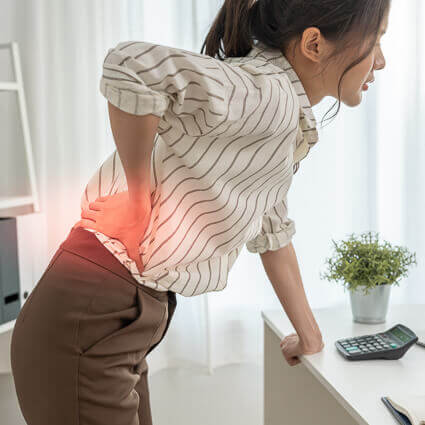
 If you have a nagging ache or a sharp, tender spot on the outer side of your hip — the kind that flares when you climb stairs, walk any distance, or lie on that side at night — you may have been told you have “hip bursitis”. It is one of the most common causes of lateral hip pain, particularly in women from mid-life onwards. It can also be surprisingly stubborn, dragging on for months and taking the enjoyment out of walking, sleeping and exercise.
This article explains what hip bursitis actually is (the name turns out to be a little misleading), why it happens, and where shockwave therapy fits in as a non-surgical option for pain that has not settled with the usual measures.
What is hip bursitis?
The greater trochanter is the bony bump you can feel on the outer side of your hip. Several important structures attach and glide around it: the gluteus medius and gluteus minimus tendons (the muscles that stabilise your pelvis when you walk), the iliotibial band, and small fluid-filled cushioning sacs called bursae that reduce friction between them.
“Bursitis” simply means inflammation of a bursa. For decades, almost any pain on the outer hip was labelled trochanteric bursitis. But modern imaging has changed the picture considerably.
The name is a bit of a misnomer. Studies using ultrasound and MRI have shown that most people with outer-hip pain do not have an inflamed bursa as the main problem. Far more often, the pain comes from wear-and-tear of the gluteal tendons (a “tendinopathy”), with the bursa involved only sometimes and usually as a secondary finding. Because of this, clinicians now group these problems under one umbrella term: greater trochanteric pain syndrome (GTPS).
So when we say “hip bursitis” in everyday language, what we are usually describing is GTPS — most commonly a gluteal tendinopathy, sometimes with a bit of bursal irritation on top. This matters, because a tendon problem and a purely inflammatory problem respond best to slightly different treatment — and it is one reason a proper assessment is worthwhile rather than guessing.
What does hip bursitis feel like? Common symptoms
The typical picture of GTPS / hip bursitis includes:
- Pain and tenderness on the outer hip, right over that bony bump, which can be sore to press.
- Pain when lying on the affected side — many people find their sleep is disturbed because they can’t settle on that hip.
- Pain with walking, stairs, and standing on one leg, or after sitting for a long time and then getting up.
- Ache that sometimes spreads down the outside of the thigh (though rarely below the knee).
- A feeling of weakness or “giving way” in the hip, or a limp after longer walks.
Symptoms often build gradually rather than starting with a single injury, and they tend to be “load-related” — worse the day after a long walk, a house move, or a spell of extra activity.
Why does it happen? Common causes and risk factors
Gluteal tendons don’t like sudden change. Problems tend to develop when the load on them outpaces their ability to adapt. Common contributors include:
- A change in activity — ramping up walking or running, starting a new exercise routine, or a period of much more (or much less) activity than usual.
- Hormonal changes around menopause, which is part of why GTPS is markedly more common in women in their 40s to 60s.
- Weak or deconditioned hip stabiliser muscles, which places more strain on the tendons.
- Sitting with legs crossed, or “hanging” on one hip when standing, which compresses the tendons against the bone.
- Differences in leg length, previous hip surgery, or altered walking mechanics after another injury.
How shockwave therapy works
Extracorporeal shockwave therapy (ESWT) is a non-invasive treatment. A hand-held applicator delivers a series of acoustic pressure waves through the skin to the painful area — no needles, no anaesthetic, no incision. The aim is to give a stalled tendon a controlled “nudge” towards repair.
The pressure waves are thought to stimulate local blood flow, prompt the body’s natural tissue-healing response, and influence the way pain signals are processed in the area. Because GTPS is, at heart, usually a tendon problem, shockwave is used here for the same reasons it is used in other well-known tendon conditions such as tennis elbow, Achilles and plantar fasciitis.
At Chiropractic First we offer both radial and focused shockwave, and can select the approach best suited to the depth and nature of your problem as part of an overall plan.
What does the evidence — and NICE — say?
It is important to be straight about this, because outer-hip pain is an area where the research is still developing.
The National Institute for Health and Care Excellence (NICE) has examined extracorporeal shockwave therapy for refractory greater trochanteric pain syndrome — meaning cases that have not responded to standard first-line care. NICE’s guidance concluded that the evidence on how well it works is limited in quality and quantity, and recommended it be used with appropriate consent, clinical governance and audit. In other words, NICE recognises it as a legitimate option to consider for stubborn cases, while being clear that the evidence is not yet as strong as for some other tendon conditions.
Individual clinical trials have shown encouraging results for some patients — with reduced pain and improved function compared with other conservative measures — but the studies are relatively small and results vary. This is exactly why we set realistic expectations from the outset, and why shockwave is offered as part of a wider plan (see below) rather than as a stand-alone “quick fix”.
Our honest position: shockwave therapy may help stubborn hip bursitis / GTPS, particularly where the problem is a gluteal tendinopathy that hasn’t settled with load management and exercise. It is not guaranteed to work for everyone, and we will tell you if we don’t think you’re a good candidate.
What to expect at Chiropractic First
Because “hip bursitis” can mean several different things, we start with a proper assessment to work out what is actually driving your pain and whether shockwave is the right tool. A typical plan might include:
- Assessment of your hip, movement and walking pattern, and how the problem is affecting daily life.
- A short course of shockwave sessions — usually delivered around once a week over several weeks. Each session takes only a few minutes of actual treatment. Some people feel a little discomfort during application and mild soreness for a day or two afterwards; this settles.
- A guided exercise and load-management plan — the part that does the heavy lifting for long-term recovery (see next section).
For deeper or more persistent tendon problems, we can also draw on EMTT (Extracorporeal Magnetotransduction Therapy) using the STORZ MEDICAL Magnetolith — Chiropractic First is one of a small number of UK clinics offering this technology alongside radial and focused shockwave.
What else helps hip bursitis?
Shockwave works best as one piece of a bigger picture. The measures with the strongest track record for outer-hip pain are usually the least glamorous:
- Load management — temporarily easing off the activities that flare it, and avoiding positions that compress the tendons (crossing your legs, standing “hanging” on one hip, sleeping directly on the sore side).
- Progressive strengthening of the hip stabiliser muscles, introduced gradually. This is the cornerstone of recovery for gluteal tendinopathy and helps prevent recurrence.
- Simple settling measures at home, and anti-inflammatory medication your GP may recommend for short-term relief.
- Injection treatments are sometimes offered elsewhere for short-term pain; evidence suggests any benefit can be short-lived, so they are generally considered alongside — not instead of — rehabilitation.
We’ll help you put these together into a realistic plan rather than leaving you to work it out alone.
When outer-hip pain needs prompt medical attention
Most lateral hip pain is not dangerous, but a few features mean you should be checked by a GP, urgent care or A&E rather than assuming it is bursitis. Please seek prompt medical advice if you have:
- Sudden severe hip pain after a fall, or an inability to stand or bear weight — this can indicate a fracture, especially in older adults or anyone with thinning bones.
- A hot, red, visibly swollen hip with fever or feeling generally unwell — possible infection, which needs urgent assessment.
- Night pain that is unrelated to position and getting worse, unexplained weight loss, or a history of cancer.
- Numbness, pins and needles, or weakness spreading down the leg, or any problems with bladder or bowel control (which would point away from a simple hip problem and need urgent review).
If in doubt, get it checked. A quick assessment can rule out the serious causes and let you treat the common one with confidence.
Frequently asked questions
What is the difference between hip bursitis and gluteal tendinopathy?
“Hip bursitis” refers to inflammation of a fluid-filled cushioning sac (bursa) on the outer hip, while gluteal tendinopathy is wear-and-tear of the gluteal tendons that attach nearby. In practice, most outer-hip pain once labelled bursitis is actually a gluteal tendinopathy, sometimes with a little bursal irritation. Both sit under the umbrella term greater trochanteric pain syndrome (GTPS), which is why the distinction is best confirmed with a proper assessment.
Does shockwave therapy work for hip bursitis?
It may help, particularly for stubborn cases driven by gluteal tendinopathy that haven’t responded to rest and exercise. NICE has examined shockwave for persistent greater trochanteric pain syndrome and found the evidence promising but limited, so it is best viewed as one option within a wider plan rather than a guaranteed cure. We’ll give you an honest view of whether you’re likely to benefit.
How many shockwave sessions are needed for hip bursitis?
A typical course is a small number of sessions spaced roughly a week apart over several weeks, though the exact number depends on how long you’ve had the problem and how you respond. We review progress as we go and adjust the plan accordingly.
Is shockwave therapy for hip bursitis painful?
Most people tolerate it well. You may feel a strong tapping sensation and some discomfort over the tender area during the few minutes of treatment, and occasionally mild soreness for a day or two afterwards. The intensity can be adjusted for comfort, and no anaesthetic or needles are involved.
Should you rest or exercise with hip bursitis?
Both, in the right balance. It helps to ease off the activities and positions that flare the pain in the short term, but complete rest tends to make tendons weaker. Gradual, guided strengthening of the hip muscles is the most important ingredient for lasting recovery, which is why we pair any shockwave sessions with an exercise plan.
Where can I get shockwave therapy for hip pain near Brighton and Hove?
Chiropractic First on Goldstone Villas in Hove offers radial and focused shockwave therapy, plus EMTT, for outer-hip pain and other tendon problems. We’re a short distance from central Brighton and easy to reach across the BN postcodes. You can book an assessment to find out whether shockwave is suitable for you.
Struggling with stubborn outer-hip pain in Hove or Brighton? Book an assessment at Chiropractic First and we’ll work out what’s really causing your lateral hip pain — and whether shockwave therapy is the right option for you.
Chiropractic First · 82 Goldstone Villas, Hove, BN3 3RU · 01273 324466 · chiropracticfirst.co.uk
Open Mon & Thu 6:45am-8:00pm · Tue & Fri 6:45am-7:00pm · Wed 8:00am-7:00pm
This article is for general information and does not replace individual clinical advice, diagnosis or treatment. Shockwave therapy is not suitable for everyone, and outcomes vary between individuals. Any treatment recommendation is made only after an individual assessment. If you are concerned about your symptoms, please consult a suitably qualified healthcare professional.