
 Quick answer
Flat feet (also called fallen arches or pes planus) are common and usually nothing to worry about. Many people with flat feet never have any pain. Because your feet are the first link in the body’s kinetic chain, the way they move can influence how load travels up through your ankles, knees and hips, and for some people foot mechanics may be one factor in problems such as heel or knee pain. Orthotics (shoe insoles) will not change the shape of your feet, but they may help with pain, stiffness or comfort for some people with symptoms. They are not needed if your flat feet are not causing problems, and NICE advises against foot orthotics for managing low back pain. A chiropractor can assess the whole chain and help with related musculoskeletal problems such as joint pain and back pain.
What are flat feet?
Most feet have an arch along the inner edge, between the heel and the ball of the foot. If you have flat feet, that arch is low or absent, so most of the sole touches the ground when you stand. You might hear it called fallen arches, flatfoot or, in clinical terms, pes planus.
Flat feet are very common. Most children have flat feet when they are young and usually develop an arch somewhere between the ages of three and ten, and plenty of adults simply have low arches as their normal foot shape. Often there is no obvious cause, and flat feet can run in families.
Flexible and rigid flat feet
Most adults with flat feet have flexible flat feet: the arch reappears when you sit down or rise onto your tiptoes, and flattens again when you stand. Rigid flat feet, where the arch stays flat even on tiptoe and the foot feels stiff, are much less common and can point to an underlying problem with the bones or joints that needs proper assessment.
Flat feet that appear in adulthood
If one foot has started to flatten, or your arches seem to be dropping when they did not before, it is worth getting checked. A gradually collapsing arch in adulthood is sometimes linked to a problem with the tibialis posterior tendon, which helps support the arch on the inner side of the ankle. This condition, now called progressive collapsing foot deformity, often causes pain and swelling along the inner ankle and can make it difficult to rise onto tiptoe on one leg. It needs assessment and, in some cases, referral to a foot and ankle specialist.
What is the kinetic chain?
Your body moves as a series of linked segments: foot, ankle, shin, knee, thigh, hip, pelvis and spine. Clinicians call this the kinetic chain, and you will also see it described as the kinematic chain. Strictly speaking, kinematics describes the movement itself, while kinetics describes the forces behind it, but both terms express the same idea: movement at one link influences the links above and below it.
Here is an example. When your foot lands, the arch naturally lowers a little to absorb shock. This is normal and healthy, and is often called pronation. As the arch lowers, the shin bone rotates slightly inwards, which in turn influences how the knee and hip line up. If the arch lowers further, or for longer, some people may place more strain on particular tissues, such as the plantar fascia under the foot or the structures around the front of the knee.
Where online advice goes too far
This is where a lot of advice online goes further than the evidence. Flat feet do not automatically cause knee, hip or back problems, and many people with very low arches never have any pain at all. Research linking foot posture to pain further up the body is mixed. Your feet are one link among many: training load, strength around the hips and calves, previous injuries, footwear and overall activity levels all play a part. That is why we look at the whole chain rather than blaming the arch.
Can flat feet cause knee, hip or back pain?
For some people, the way the foot moves may be one contributing factor in problems such as heel pain, shin pain or pain at the front of the knee. The link with back pain is much weaker.
NICE, which publishes clinical guidance for the NHS in England, advises that foot orthotics should not be offered for managing low back pain, with or without sciatica. So if back pain is your main problem, insoles are not the answer, and we will not recommend them for it. Chiropractic care can help with back pain itself; you can read more in our guide to chiropractic for back pain.
Do orthotics help flat feet? What the evidence says
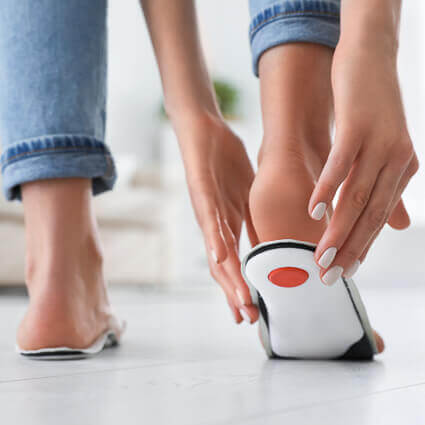
Orthotics are insoles that sit inside your shoes to support the foot. They range from off-the-shelf arch supports to custom-made devices shaped to your feet. Here is an honest summary of what they can and cannot do.
What orthotics cannot do
- Change the shape of your feet or build an arch. As the NHS puts it, insoles will not change the shape of your feet, though they can help with things like pain or stiffness.
- Straighten or “realign” your spine, hips or pelvis.
- Help everyone. Responses vary, and some people notice little difference.
What the research suggests they may do
Reviews of the research on adults with flexible flat feet have found no high-level evidence for orthotics, but good-to-moderate evidence that they can improve some aspects of physical function, such as standing balance and the energy cost of walking. There is lower-level evidence that they may reduce pain and how much the heel rolls inwards. A 2022 review concluded that firm conclusions were not possible, although its pooled results suggested orthotics might help reduce pain in adults whose flat feet are causing symptoms.
In practice, that means orthotics are best seen as one tool for people whose flat feet are linked with symptoms, used alongside exercise and sensible footwear rather than on their own.
Off-the-shelf or custom-made?
Custom orthotics are not automatically better. For many people, a good-quality off-the-shelf insole is a sensible first step. Custom-made orthotics may be worth considering if off-the-shelf options have not helped, your feet are very different from each other or unusually shaped, or you need a specific modification.
How chiropractic care fits in
Chiropractic care will not change the shape of your feet. What it can offer is a thorough look at the whole kinetic chain, and help with related musculoskeletal problems. Chiropractic care can help with joint pains, generalised aches and pains, back pain and minor sports injuries, and with the short-term management of ankle sprains and plantar fasciitis.
At Chiropractic First, your assessment typically includes:
- A history of your symptoms, activity, footwear and any previous injuries
- Your standing foot posture, including whether your arches are flexible or rigid
- How you walk, plus simple movement tests such as single-leg balance and a single-leg squat
- The mobility and strength of your feet, ankles, knees, hips and lower back
- Checks for any signs that need onward referral
Depending on what we find, your plan may include:
- Hands-on treatment of the joints and soft tissues involved in your pain
- A targeted exercise programme for your feet, calves and hips
- Footwear advice for work, everyday wear and sport
- Advice on whether orthotics are worth trying and, just as importantly, telling you when they are not needed
- Referral to your GP or a podiatrist where that is the better route
We supply orthotics here at the clinic. If we think they are worth trying, we will talk you through the options, and what they cost, before anything is ordered. We do not routinely X-ray flat feet: our on-site digital X-ray is used only where there is a clear clinical reason, and every exposure has to be justified.
Simple self-help for tired or achy feet
- Supportive footwear: choose shoes with a firm heel and some arch support for everyday wear and sport, and avoid spending long periods in completely flat, unsupportive shoes.
- Build up gradually: increase running, long walks or standing time a little at a time.
- Calf stretches and calf raises: these work the muscles that help support your ankle and arch.
- “Short foot” exercise: sitting with your foot flat, gently draw the ball of your foot towards your heel so the arch lifts, without curling your toes. Hold for a few seconds and repeat.
- Single-leg balance: for example, while brushing your teeth.
- Hip strengthening: side-lying leg raises help control further up the chain.
Stop any exercise that causes sharp or worsening pain, and get advice if symptoms persist.
When to see a GP or get urgent advice
See a GP or podiatrist if you have flat feet and:
- Your feet are painful, stiff, weak or numb
- You did not have flat feet before, or one foot is flattening
- You often injure your feet or ankles
- Your child has flat feet with pain, stiffness, a limp or frequent tripping, only one foot looks flat, or no arch appears when they stand on tiptoe
Get urgent advice through NHS 111, your GP, an urgent treatment centre or A&E, as appropriate, if you have:
- A hot, red or swollen foot, especially if you have diabetes, even if it is not painful
- A sudden pop or snap, or you cannot put weight on your foot after an injury
- Calf pain, swelling or warmth in the lower leg, which can be a sign of a blood clot
- Numbness, pins and needles, or a change in the colour or temperature of your foot
- A painful, swollen foot with a fever or feeling unwell
In an emergency, call 999.
Frequently asked questions
Can a chiropractor help with flat feet?
A chiropractor cannot change the shape of your feet, and flat feet that are not causing problems do not need treatment. Where flat feet are linked with symptoms, a chiropractor can assess the whole kinetic chain, from your feet to your lower back, and help with related musculoskeletal problems such as joint pains, back pain, minor sports injuries and the short-term management of plantar fasciitis. Care usually combines hands-on treatment, exercises and footwear advice, with orthotics considered only where they are likely to be useful.
Do flat feet cause back pain?
Not necessarily. Many people with flat feet never have back pain, and research linking foot posture to back pain is mixed. Back pain usually has several contributing factors, including activity levels, strength, sleep and stress. NICE advises that foot orthotics should not be offered for managing low back pain, with or without sciatica. Chiropractic care can help with back pain, and a thorough assessment looks at the whole picture rather than blaming your arches.
Do orthotics fix flat feet?
No. Orthotics do not change the shape of your feet or create an arch. What they may do, for some people with symptoms, is help with pain, stiffness or comfort, and some research suggests they can improve aspects of function such as standing balance. Responses vary from person to person, and orthotics generally work best alongside exercise and suitable footwear.
Should I wear insoles if my flat feet don’t hurt?
Usually there is no need. The NHS advises that you do not need to do anything if flat feet are not causing problems, and for many people a low arch is simply their normal foot shape. If your feet are comfortable and you are active without pain, supportive everyday footwear is generally enough. Get advice if you develop pain, stiffness or weakness, or notice one foot flattening.
Are custom orthotics better than off-the-shelf insoles?
Not automatically. For many people, a good-quality off-the-shelf insole is a sensible first step and can be just as helpful. Custom-made orthotics may be worth considering if off-the-shelf options have not helped, if your feet are very different from each other or unusually shaped, or if you need a specific modification. A clinician should explain why they are suggesting one option over another, and what it will cost, before anything is ordered.
How can I tell if I have flat feet?
Stand barefoot and look at the inner edges of your feet. If the inner arch is raised off the ground, you do not have flat feet; if most of your sole touches the floor, you may have. A wet footprint can help too, as a print showing the whole sole suggests a low arch. Then rise onto your tiptoes: if an arch appears, your flat feet are likely to be flexible, which is the most common and usually harmless type.
Book an assessment in Hove
If foot, knee, hip or back pain is getting in the way of work, walks along the seafront or your sport, book an assessment at Chiropractic First. We will look at the whole chain, explain what we find in plain English, and be honest about what will and will not help, including whether you need orthotics at all.
Chiropractic First has been part of the Hove community since 2006. You will find us at 82 Goldstone Villas, Hove BN3 3RU, a short walk from Hove station, and we see patients from across Brighton & Hove, Portslade and Shoreham-by-Sea. We open from 6:45am on Mondays, Tuesdays, Thursdays and Fridays, and until at least 7pm every weekday.
Call 01273 324466 or book online.
Related reading
- Chiropractic for back pain
- Sciatica: how chiropractic care can help
- Hip bursitis (GTPS): how shockwave therapy may help
- Shockwave therapy for plantar fasciitis (Hove Shockwave)
About the author
Dr Lewis Kingsnorth DC MChiro is a chiropractor registered with the General Chiropractic Council (GCC Reg. 3359) and a member of the United Chiropractic Association. He holds a Master of Chiropractic (MChiro) from the Welsh Institute of Chiropractic, has been qualified since 2009, and leads Chiropractic First in Hove, a clinic that has served the local community since 2006.
Disclaimer: This article is for general information only and is not a substitute for an individual assessment or medical advice. Orthotics and chiropractic care are not suitable for everyone, and results vary between individuals. If you are worried about your symptoms, speak to your GP or another qualified healthcare professional.